

Inflation was good in June and July; August’s will not be so kind
Raymond James Chief Economist Eugenio J. Alemán discusses current economic conditions.
The softening inflation data for June and July was broadly supportive of our view that monetary policymakers should keep interest rates unchanged for the remainder of the year. Unfortunately, the picture is likely to become less favorable over the next several months, particularly if oil and gasoline prices continue to move higher. While lower gasoline prices contributed to the improvement in inflation during June and July, they do not tell the whole story.
The biggest surprise in the Consumer Price Index (CPI) over the past two months was the unusually small increase in shelter prices, which rose just 0.1% month over month in both June and July. Importantly, this moderation was not driven by a meaningful slowdown in owners' equivalent rent (OER), which represents roughly 73% of the shelter component and carries a weight of approximately 25.8% in the overall CPI basket. In fact, OER accelerated in July, rising 0.3% month over month after increasing 0.2% in June.
So why did the shelter component remain so subdued? The answer lies in the lodging-away-from-home category, which includes hotels and motels. Although this category accounts for only about 4.1% of the shelter component and an even smaller share of the overall CPI basket, it fell sharply, declining 2.3% in June and another 2.8% in July on a seasonally adjusted basis.
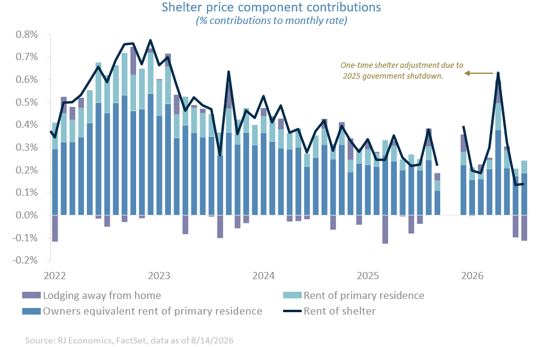
As a result, the recent slowdown in shelter prices appears to have been driven disproportionately by this small and volatile component rather than by a broad-based easing in housing prices. Both OER and rent of primary residence remained relatively firm, while lodging away from home made unusually large negative contributions to shelter prices in June and July. If lodging prices had instead increased at their average monthly pace over the last decade, the rent of shelter component would have been approximately 0.24% in June and 0.26% in July, rather than the reported 0.13% and 0.14%, respectively.
This suggests that recent shelter readings may be overstating the degree to which shelter prices are contributing to disinflation and, by extension, the degree of underlying core CPI improvement. That distinction is unlikely to be overlooked by Federal Open Market Committee (FOMC) members as they prepare for their September meeting.
Moreover, policymakers will have the August CPI report in hand before that meeting. We expect that report to be considerably less encouraging, with higher gasoline prices pushing headline inflation higher and a likely rebound in lodging away from home limiting any further moderation in shelter prices. As a result, the September policy discussion could prove more challenging than current market expectations suggest.
What does it mean for the Federal Reserve?
Beyond inflation, the labor market has continued to cool. Average monthly job gains have slowed from approximately 94,000 through June to about 61,000 through July. We still expect payroll growth to average approximately 70,000 per month this year, a pace consistent with a moderating, rather than deteriorating, labor market.
At the same time, July retail and food services sales came in weaker than expected as consumers pulled back on several big-ticket categories, including automobiles, electronics and appliances. Lower gasoline prices also weighed on gasoline station receipts during the month.
While the report was soft, several temporary factors may have contributed to the weakness. Calendar effects, the conclusion of the World Cup and the timing of retailer promotions, some of which occurred in June rather than July, may have shifted spending across months. Strong back-to-school purchases may also have redirected spending away from other retail categories. For now, we view July's retail sales weakness as more of a temporary setback than the beginning of a sustained slowdown in consumer activity. Nevertheless, we will continue to monitor incoming data closely for signs that softer consumer spending is becoming a more meaningful drag on economic growth.
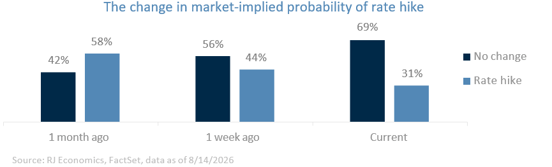
Taken together, the latest inflation, labor market and spending data continue to support our view that the Federal Reserve should remain on hold for the rest of the year. Inflation remains sufficiently sticky to argue against near-term easing, while cooling labor demand and softer consumer spending reduce the case for additional tightening. As a result, the probability of a September rate hike has continued to decline, with markets currently assigning roughly a 30% chance, down from about 50% less than a month ago.
Economic and market conditions are subject to change.
Opinions are those of Investment Strategy and not necessarily those of Raymond James and are subject to change without notice. The information has been obtained from sources considered to be reliable, but we do not guarantee that the foregoing material is accurate or complete. There is no assurance any of the trends mentioned will continue or forecasts will occur. Past performance may not be indicative of future results.
